
Login Form


Polls
How do you rate our new layout?
 

Who We Are

LAL is a registered charity whose aims are to promote education and training in laboratory animal science. We fund a range of initiatives in the field of laboratory animal science including bursaries to attend appropriate training courses, speakers at scientific meetings, financial assistance for workshops the proceedings of FELASA conferences and of course our journal - Laboratory Animals.

Read more...

The Journal

To find out more about our journal, Laboratory Animals: The International Journal of Laboratory Animal Science & Welfare click here

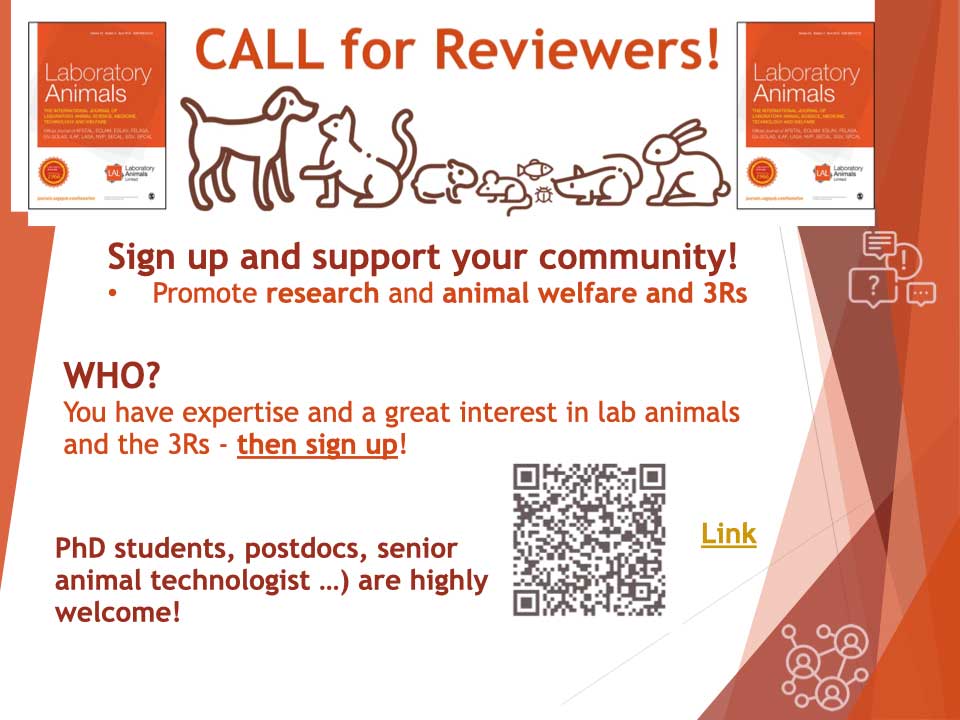
Front cover of Laboratory Animals journal

The journal has published numerous guidlines and working group reports on animal use, care and welfare. To access these articles, please visit the website.

How to access your online version

  1. Access www.rsmjournals.com/activate/personal
  2. Enter your personal subscriber reference number – printed on the mailing label of the print copy
  3. Enter your name, address and choose username and password
  4. In case of problems, email to: 
Understanding Animal Research News Feed
  • European Directive 2010/63/EU: UK government responds

    The Government has responded to the public consultation on the options for transposition of Directive 2010/63/EU. It expects to publish regulations to transpose the provisions of the Directive into UK legislation in July, before the start of the summer recess. We have welcomed the long-awaited announcement. The new legislation promises to retain the best of existing UK law, including a ban on the use of great apes and special exemptions for dogs, cats and horses, while extending protections for wild-caught animals.

  • Animal research crucial for future of the NHS

    Last month, Prime Minister David Cameron made a commitment to delivering major improvements in dementia care and research, doubling the budget for Alzheimer’s research in the UK to £66 million. Today, Stephen Whitehead, Chief Executive of the Association of the British Pharmaceutical Industry (ABPI) said in a keynote speech that

    'the simple fact is that if we don’t find cures or treatments for age-related diseases like Alzheimer’s then, as the population ages, the NHS will become unaffordable.'

  • NEW! Classroom poster

    UAR is sending a colourful new A1 poster - Discovering New Medicines - to every secondary school in Britain. If you would like a copy please contact our schools education officer Alexandra Jenkin by email: or download a high resolution copy of the poster here: http://bit.ly/IRcmhq (but not good enough to print at A1 size).

  • Moving animals - are we at a tipping point?

    Scientists and governments are increasingly concerned about the negative impact of animal rights campaigns on the humane transportation of animals for research. As revealed by the BBC Radio 4 Today programme and The Times this morning (Wednesday 14 March), this situation is reaching a tipping point where we may no longer be able to transport these animals in safety and comfort, seriously damaging the research that will bring us medical benefits in future.


  • Stem cells win prizes

    Liver cells that mimic inherited liver diseases, produced from human skin cells, may offer the chance to regenerate damaged tissues and organs. But the potential of these 'human induced pluripotent stem cells' (hIPSCs) to reduce the number of animals needed to screen potential medicines has led to a prize for scientist Dr Ludovic Vallier at University of Cambridge.

    The prize was awarded by the National Centre for the Replacement, Refinement and Reduction of Animals in Research (NC3Rs) and sponsored by GlaxoSmithKline. It comprises a £2,000 personal award and a £18,000 research grant. Professor Vallier receives his prize from Professor Paul Matthews OBE of GlaxoSmithKline at the NC3Rs Annual Science Review Meeting in London on 28 February.

    Human liver cells (hepatocytes) cannot be grown in the laboratory, and differences between rodents and humans mean that it is rarely possible to recreate the human disease exactly in mice or rats or to use cultures of rat or mouse liver cells. Dr Vallier’s team took skin cells (dermal fibroblasts) from seven patients with a variety of inherited liver diseases and three healthy individuals (the controls). They then reprogrammed cells from the skin samples so they turned back into stem cells.

laltestbanner